



5 Spooky Movie Vehicles and the Stories Behind Them
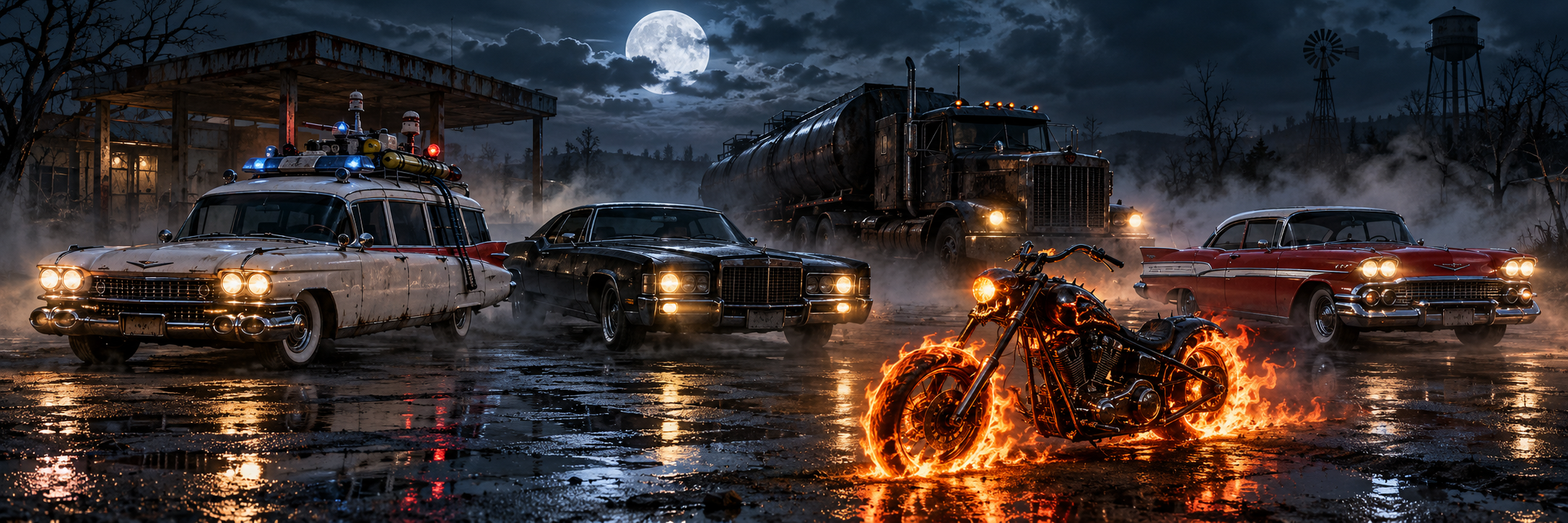
Five spooky vehicles from the movies
A memorable screen vehicle needs more than a dramatic entrance. The right body shape, paintwork and mechanical details can tell you what sort of character you’re looking at before anyone says a word.
For Halloween, we’ve chosen five vehicles with stories behind the machinery. One started life as an ambulance. Another was built from three Lincolns. And Steven Spielberg held auditions for one of the others. Here’s our Top 5.
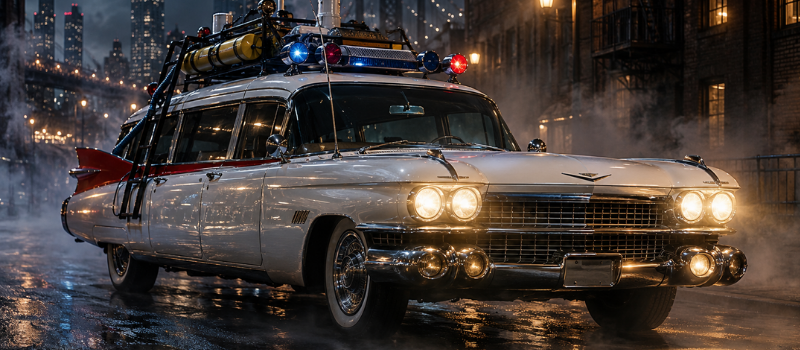
5. Ecto-1: the Cadillac ambulance in Ghostbusters (1984)
We’re starting with a friendly choice. Ecto-1, the Ghostbusters’ unmistakable car carries the team and their equipment around New York.
Ecto-1 is a 1959 Cadillac fitted with a Miller-Meteor ambulance body. Miller-Meteor was a coachbuilder that converted Cadillacs for specialist uses, including ambulances and hearses. That explains Ecto-1’s unusual proportions: the long roof and substantial rear compartment gave the Ghostbusters space for a crew and all their equipment.
The choice of an old ambulance came from Ghostbusters co-writer and star Dan Aykroyd. The car in his early concept looked rather different, though. It was black, with white and purple flashing lights, giving it a much more ominous appearance. For the finished film, the vehicle acquired its familiar lighter paint scheme, red fins, roof equipment and ghost logo. Film hardware designer Steven Dane developed and supervised the conversion of the Cadillac into the Ectomobile.
Aykroyd’s interest went beyond choosing a suitably large American car. When the original Ecto-1 was refurbished years later, he could still explain what the various pieces of fictional equipment on its roof were meant to do. The refurbishment team also had some very real Cadillac problems to solve, including work on its brakes, suspension, steering, wiring and fuel system. Even ghost hunters can’t escape vehicle maintenance.
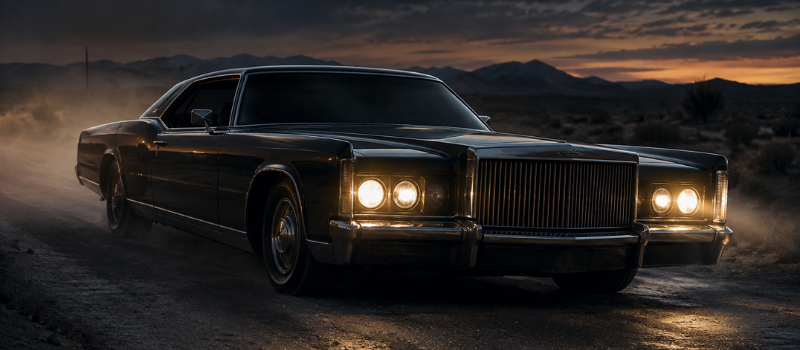
4. The customised Lincoln in The Car (1977)
The menacing vehicle in The Car (the least known film on our list) wasn’t a factory model dreamed up for a showroom. It was created from three customised Lincoln Continental Mark III cars. Hollywood car customiser George Barris and stunt coordinator Everett Creach worked on the design for the 1977 film. Barris had already built some of television’s best-known special vehicles, including the 1960s Batmobile.
Their brief was to make the Lincoln look huge and aggressive. They lowered its roof, raised its side panels and finished it in dark charcoal grey. The windows were treated so the stunt drivers could see out while the audience couldn’t see in. That last detail matters: the car appears to have a will of its own because there’s no visible driver to explain its actions.
According to the American Film Institute’s production history, each customised car weighed 5,550 pounds, or about 2.5 tonnes. It’s a fitting physical presence for a film in which a small town struggles to stop a vehicle that seems determined to terrorise it.
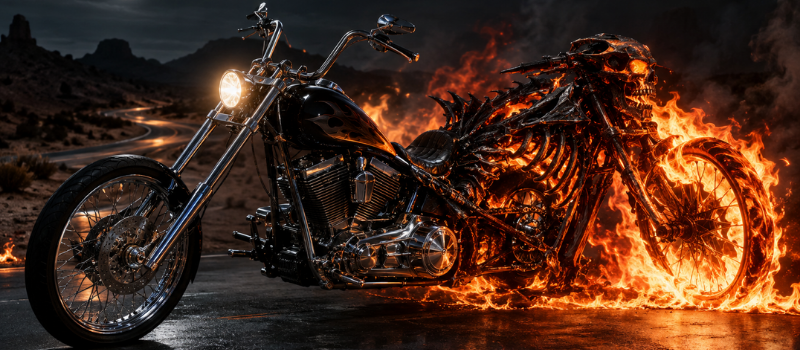
3. Grace and the Hell Cycle in Ghost Rider (2007)
Nicolas Cage plays motorcycle stunt rider Johnny Blaze in Ghost Rider. Before his supernatural transformation, Blaze rides a custom chopper called Grace. When he becomes Ghost Rider, the bike transforms into the far more threatening Hell Cycle.
There’s a useful distinction for bike enthusiasts here. Cage said during filming that he rode Grace and a separate Buell stunt motorcycle. He didn’t claim to ride the fiery Hell Cycle through its supernatural scenes. The production used a physical design for the demonic bike alongside visual effects to create the transformation and flames.
Director Mark Steven Johnson said members of the visual effects team were motorcycle riders themselves. They paid attention to small details, such as how a rider leans while cornering, even when the bike was doing things no ordinary motorcycle could do. That grounding helps sell the more outlandish sight of a flaming machine charging through the film.
2. The tanker in Duel (1971)
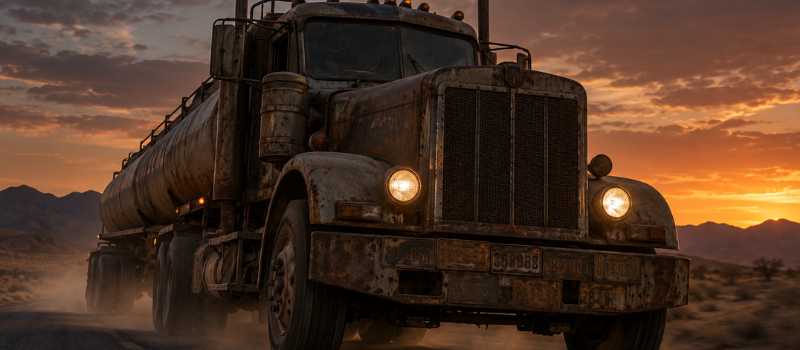
The truck pursuing Dennis Weaver’s travelling salesman in Steven Spielberg’s breakout TV movie, Duel, is a Peterbilt 281 tanker. Its long bonnet, split windscreen and round headlamps give it an unmistakable face. Spielberg chose it from a group of trucks brought to the studio for what he described as a casting call. He preferred its older, long-nosed shape to the flatter-fronted alternatives.
The truck was then made to look as though it had spent years on hostile roads. The crew dirtied it heavily and added number plates from several US states to its front. Spielberg explained that the plates suggested previous victims along its route. The detail is easy to miss on a first viewing, but it gives the vehicle a history without a line of dialogue!
We see signs of the driver, including a hand and boots, but never his face. Spielberg credited that decision to Richard Matheson’s screenplay. As he put it in a later interview: “The unseen is more frightening than what you throw in the audience’s face.” With no face to focus on, it’s the Peterbilt that becomes the villain.
Originally made for American television, Duel aired in November 1971. It’s a remarkably effective piece of motoring suspense built around two vehicles, an empty road and a driver who cannot understand why he’s being pursued.
1. The Plymouth Fury in Christine (1983)
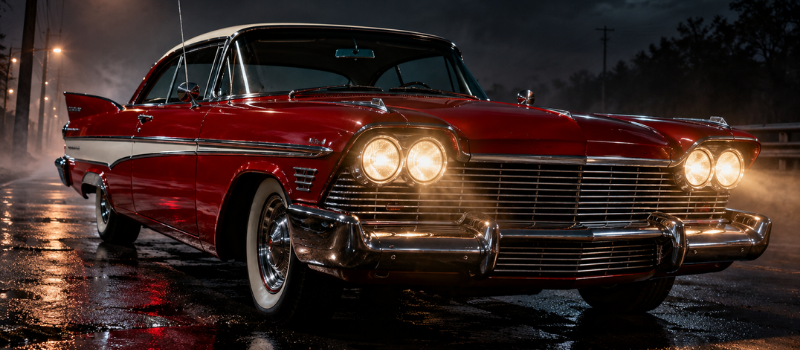
Christine is identified in the film as a 1958 Plymouth Fury. With its tailfins, broad grille and generous chrome, it already has plenty of presence before anything supernatural happens. Its red-and-white finish makes it stand out even more.
John Carpenter’s film, based on Stephen King’s novel, follows teenager Arnie Cunningham as he restores the neglected car. As Christine improves, Arnie changes too. The car grows possessive and proves capable of far more than an ordinary American car...
For a car enthusiast, one of the most striking scenes is Christine apparently repairing her own battered bodywork. That effect had a clever mechanical solution. The crew fitted hydraulics inside a hollowed-out car to pull its body panels inwards, then played the footage backwards. On screen, the crushed metal seems to push itself back into shape.
That earns Christine first place in our list. The Lincoln was customised to look evil and Spielberg’s Peterbilt was cast for its threatening face. Christine begins as a desirable classic car but then the film makes you wonder whether owning her is the worst decision a motorist could make. A thought a few classic car owners might have shared along the way...
So, if your classic starts behaving strangely this Halloween, making noises you don’t recognise or appearing to have a mind of its own, it might be worth checking the garage door is firmly shut...
Happy Halloween!
Sources:
Ecto-1: Ecto-1: Resurrecting the Classic Car, which covers Dan Aykroyd’s roof equipment explanations and the restoration work. slashfilm.com
The Car: American Film Institute production history, including the three customised Lincolns, Barris and Creach, the windows and the 5,550-pound weight of each car.
Ghost Rider: Nicolas Cage’s set interview on Grace, the Buell and the Hell Cycle, plus director Mark Steven Johnson’s interview on the motorcycle-riding visual effects team.
Duel: Spielberg’s filmed interview transcript covers the truck casting call, number plates and unseen driver.
Christine: American Film Institute entry for the film and car, plus John Carpenter’s interview explaining the hydraulics and reversed footage. catalog.afi.com