



Driverless taxis are now on London’s roads. Are we ready?
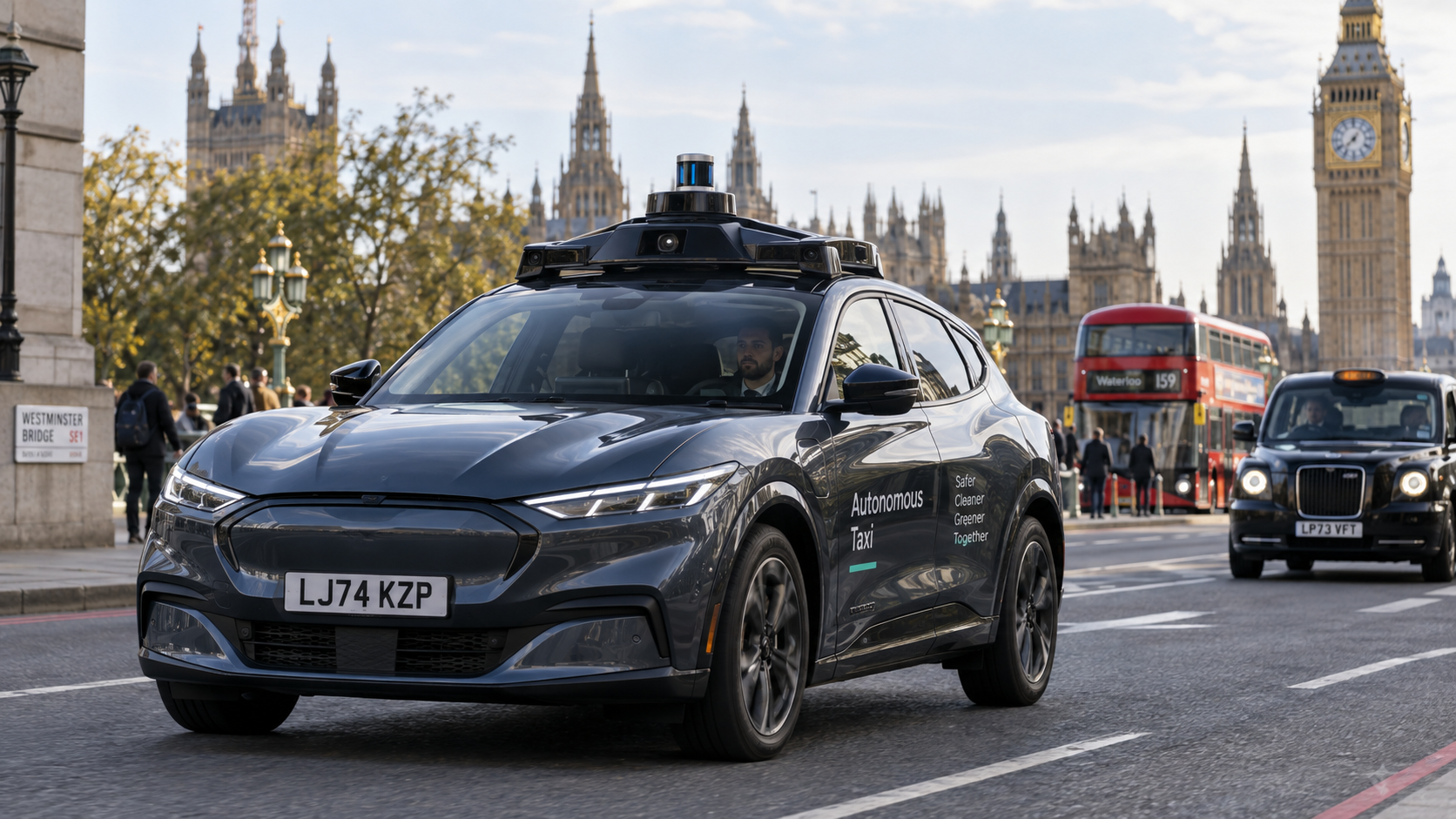
Londoners booking an Uber taxi ride may now be matched with a car that drives itself.
Uber and British autonomous vehicle company Wayve launched supervised autonomous rides in the capital on 3 September 2026. The small initial fleet consists of electric Ford Mustang Mach-E vehicles fitted with Wayve's automated driving system and surrounding sensors.
Passengers can accept the vehicle or switch to an ordinary Uber. The service can operate across London, excluding airports, and costs no more than the equivalent Uber journey.
There is one detail worth stressing. These taxis are not unattended robotaxis. A trained, Transport for London-licensed private hire driver remains in the driving seat to supervise every journey and take control if necessary.
For insurance and legal purposes, that human presence makes the present trial rather different from the genuinely driverless services expected later.
At Grove & Dean, we've watched vehicle technology change considerably over the years. Features such as automatic emergency braking, adaptive cruise control and lane-keeping assistance have gradually moved into everyday cars.
Fully automated driving is a much larger step, but the same principle applies. As vehicles change, insurers must understand the new risks and make sure motorists, passengers and other road users remain properly protected.
Why trial the technology in London?
London gives autonomous systems a stern examination. Its roads include busy junctions, narrow streets, cyclists, pedestrians, roadworks and drivers whose interpretation of a yellow box can occasionally be rather imaginative.
Wayve has trained and tested its technology in the capital since 2018. The company says its system learns from experience instead of depending solely on detailed maps or rules written for every possible situation.
The potential benefits reach beyond technological novelty.
Automated taxis could provide more freedom for older people, disabled passengers and others who cannot or prefer not to drive. They might also give people an alternative to owning a car, particularly in towns and cities.
However, those benefits will depend on how reliably the technology performs, the availability and affordability of services, and whether passengers have confidence in their safety.
From Grove & Dean's point of view, greater independence and safer roads would plainly be welcome.
However, public confidence will depend on more than whether the vehicles work most of the time.
People will also want to know what happens when they don't...
Are driverless cars safer than human drivers?
They may become safer, but it is too early to claim that every autonomous car is already safer than every human driver.
Different systems work in different places and under different limits. Evidence gathered on wide American roads, for example, cannot simply be applied to every British street, weather condition or traffic situation.
There is still a strong reason to investigate the technology's potential safety benefits.
Government analysis found that human error was recorded as a contributing factor in 88% of road collisions in Great Britain in 2020.
Automated vehicles could potentially reduce risks associated with tiredness, distraction and impaired driving. They don't drink, become tired, check a mobile phone or lose their temper with the driver in front.
That doesn't make the technology infallible.
Sensors can be affected by poor conditions. Software can misread an unusual situation. Digital systems can fail or face cyberattack. A vehicle may also have to interact with a human driver whose next move is anything but logical.
UK law therefore sets a demanding test.
Under the Automated Vehicles Act 2024, the safety principles must be designed to ensure authorised self-driving vehicles achieve a level of safety equal to or higher than that of a careful and competent human driver. The principles must also aim to improve overall road safety in Great Britain.
At Grove & Dean, we believe this is the right starting point. New technology should be judged by evidence gathered on real roads, rather than promises made in ideal conditions.
The standard must remain demanding as the number of automated vehicles grows.
Who is responsible if a driverless car causes a crash?
With a conventional vehicle, an insurer will usually examine what the people involved did. Was a driver speeding, distracted or otherwise negligent?
That approach cannot work in quite the same way when software is performing the driving task.
The UK began addressing this through the Automated and Electric Vehicles Act 2018.
Where a listed automated vehicle is driving itself, is insured and causes an accident on a road or other public place in Great Britain, the Act makes the motor insurer liable for the resulting damage, subject to the statutory requirements.
The Act also provides for owner liability in certain specific circumstances where a vehicle is exempt from compulsory insurance requirements. This does not automatically make every owner of an uninsured automated vehicle liable under the Act.
The framework provides an injured person with a route to compensation without first having to prove whether a line of code, sensor, manufacturer, software supplier or fleet operator was at fault.
The insurer can then investigate whether another organisation should ultimately bear some or all of the cost.
This victim-first approach makes sense to us at Grove & Dean. Someone injured in a collision shouldn't have to conduct a technical investigation before they can begin a claim.
There needs to be a clear route to compensation, followed by a separate examination of where the fault originated.
There are exceptions. Compensation may be reduced if an injured person was partly responsible.
An insurer may also have rights against the policyholder if prohibited software changes or a failure to install safety-critical updates contributed to the accident.
The facts and applicable legislation will matter in every claim.
How will responsibility work when there is no driver at all?
The Automated Vehicles Act 2024 creates a clearer division between the person using the vehicle and the organisations responsible for its automated operation.
Every authorised automated vehicle will need an "authorised self-driving entity".
This will normally be the manufacturer or developer accepting legal responsibility for how the vehicle drives while its self-driving feature is active.
For vehicles that complete an entire journey without a user in charge, a licensed operator will handle matters such as roadworthiness, breakdowns and incident response.
The person in the vehicle will generally not be legally responsible for the way it drives while an authorised self-driving feature is operating within its approved conditions.
They can still be responsible for duties outside the driving task.
This could include following a valid request to resume control in a vehicle designed to hand control back, or ensuring that children wear seatbelts.
Much of this system isn't yet in full operation. The Government is preparing the secondary legislation and detailed safety rules needed to put it into practice.
Full implementation is currently expected from the second half of 2027.
Until then, supervised services such as the Uber and Wayve launch remain a useful step towards the future, rather than its finished form.
What does this mean for motor insurers and brokers like Grove & Dean?
Insurance remains central because an accident victim needs a clear and prompt route to compensation.
The difficult argument about whether the fault began in software, hardware, maintenance or human action shouldn't be the victim's first obstacle.
For insurers and brokers such as Grove & Dean, the task will be to understand a very different mixture of risks while continuing to give customers clear information about their cover.
Insurers will need reliable access to vehicle data. A claim may depend on questions such as:
Was the automated system active at the moment of impact?
Was the vehicle operating within the roads, speeds and weather conditions for which it was authorised?
Did it request that a human take control, and was enough warning given?
Had required software and security updates been installed?
Was there a mechanical fault, damaged sensor or cyber incident?
Without secure and standardised data, apparently straightforward claims could become slow disputes between insurers, manufacturers, software businesses and operators.
Access must also respect privacy and prevent commercially sensitive information from being used improperly.
Repair costs present another problem.
Automated vehicles may contain cameras, radar and other sensors that need accurate recalibration after even a modest collision.
A repaired bumper must do more than look straight. The systems behind it must still understand the road correctly.
Pricing will change too.
Familiar details such as a driver's age, experience and claims history may become less useful when a vehicle is operating fully autonomously.
The safety record of the vehicle's software, its operating area, update history and repair network could become more relevant.
For brokers, this could make giving accurate information about the vehicle particularly important.
Two outwardly similar cars may present very different risks depending on their software, sensors and authorised driving features.
Drivers will also need to understand the difference between assistance and automation.
A car with lane-keeping assistance or adaptive cruise control may still require the driver to remain responsible and attentive at all times.
Calling such a vehicle "self-driving" could create dangerous confusion and serious questions during a claim.
Will driverless cars make insurance cheaper?
We're sure this is a question many people will want the answer to!
Well... possibly, but it would be unwise to assume they will.
Driverless vehicles could eventually cause fewer collisions. If they do, that would be welcome news for road users and insurers.
However, lower accident frequency doesn't necessarily mean simpler or cheaper claims.
Automated vehicles can be expensive, their technology is complex and a fault in one system could affect many vehicles at once.
Cameras and sensors can also make repairs more costly. Even minor bodywork damage may require specialist inspection and recalibration before the vehicle is safe to return to the road.
Premiums will ultimately depend on real claims evidence.
Insurers will want to know how often each system is involved in an accident, how severe those accidents are and how much the vehicles cost to repair.
It will take time to gather enough reliable information to understand whether automated driving will reduce insurance costs and, if so, for which vehicles and circumstances.
Grove & Dean's View of the Road Ahead
The arrival of supervised autonomous Uber rides in London is a genuine step towards a different kind of motoring.
It also demonstrates why the change is likely to be gradual.
The present vehicles still have a licensed driver ready to take control. The full legal framework for vehicles operating without a responsible driver is still being completed.
Questions around data, repairs, cybersecurity and responsibility continue to be worked through.
From our perspective, motor insurance won't disappear with the driver. Its focus will change.
The insurance industry will increasingly need to examine how a complete transport system behaves, including the vehicle, its software and the organisations responsible for keeping it on the road.
Britain's congested and often unpredictable roads will be a demanding proving ground.
If autonomous vehicles can work safely here, they could provide greater independence for people who cannot drive and help reduce collisions caused by human error.
For Grove & Dean, the basic principle remains unchanged.
Whatever is sitting in the driving seat, people injured in a collision need to know who is responsible and how they will be compensated.
Motoring Is Changing. Is Your Insurance Up to Date?
From everyday cars to vehicles with increasingly advanced technology, having suitable motor insurance remains important. Explore Grove & Dean's car insurance options and get a quote today.